What Is Glitch Text? The Complete Guide, History & How It’s Made
You’ve seen it in a Discord bio, a horror meme, or a username that looked like it was falling apart on screen: letters wrapped in tiny marks, stretching above and below the line as if the text itself were malfunctioning. That’s glitch text, and despite how common it’s become, most people who use it couldn’t explain what’s actually happening to make it look that way.
If you’ve ever asked yourself, “What is glitch text?” in plain terms, this guide covers the meaning behind the name, traces its origin back further than most people realize, and breaks down exactly how glitch text is made at a technical level. By the end, you’ll understand it well enough to use it correctly, rather than just pasting it and hoping it works.
What Is Glitch Text
Glitch text is normal writing that’s been layered with extra Unicode characters, making it look distorted, corrupted, or broken. Think of a word like “hello” transformed into something with jagged marks stacking above, below, and through each letter, giving the impression that your screen is malfunctioning.
It isn’t actually a glitch in the technical sense. Nothing is broken. It’s closer to a clever workaround: a feature of the Unicode text standard being used in a way its designers probably never pictured. Because of how standard encoding works, you can often copy-paste cursed text into most modern apps, though some platforms filter heavy character stacking. That’s part of why the name stuck. The result looks exactly like a rendering error, even though every character is displaying precisely as intended.
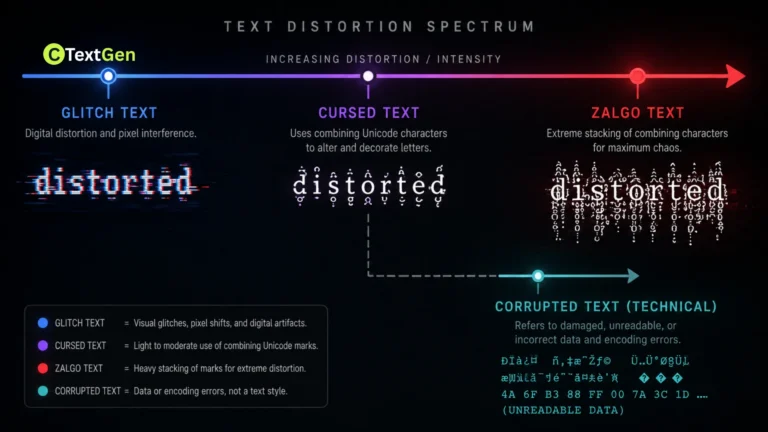
You’ll often see glitch text used interchangeably with “Zalgo text” and “cursed text.” They’re related, but not identical, and understanding the difference actually matters if you want predictable results.
Glitch Text vs Zalgo Text vs Cursed Text
- Glitch text typically refers to a moderate level of distortion. Enough marks are stacked on each letter to create a jagged, cyberpunk, “corrupted signal” look, while the words stay clearly readable.
- Zalgo text pushes the same technique to its extreme. Marks pile up so heavily that letters overflow their line height entirely, producing the dripping, chaotic look associated with horror content.
- Cursed text is the broadest term of the three. It covers Zalgo, lighter glitch effects, and other unsettling text styles, tied to the general internet slang meaning of “cursed” as something strange or off-putting.
All three rely on the same underlying mechanism. For a full breakdown comparing each format side-by-side, check out the complete guide on cursed text vs glitch text vs zalgo vs corrupted text. The only real difference is intensity and the aesthetic each one is going for.
The Meaning and Origin of Glitch Text
To understand the meaning of glitch text, it helps to know where the visual style actually came from, because it didn’t start as a design trend. It started as an internet horror joke.
The Zalgo Creepypasta Connection
The distorted lettering style traces back to 2004, when a member of the Something Awful forums began posting edited comic strips, including Nancy and Archie panels, where the artwork and dialogue looked increasingly warped. The joke centered on an unseen, world-consuming entity referred to as “Zalgo,” and the corrupted text in those posts became the visual signature of that running gag. The mythology grew from there, eventually becoming a recognized piece of creepypasta lore, alongside a broader internet meme culture built around anonymous horror storytelling on forums like Something Awful and later 4chan.
The name Zalgo stuck to the text style itself, even after most people had never seen the original comic edits. Once early online tools made the effect available to anyone with a keyboard, it stopped being tied to one specific joke and became a general-purpose format.
Why It Started Being Called Glitch Text
As the style spread beyond horror communities, people needed language for lighter, more restrained versions of the effect, ones meant to look like digital distortion or a corrupted signal rather than full-blown horror-movie chaos. “Glitch text” filled that gap. It borrowed the visual language of technology breaking down, static, screen tearing, corrupted data, and applied it to a more moderate stacking of the same Unicode marks. This made it a natural fit for cyberpunk, hacker, and sci-fi aesthetics, not just horror content.
By the 2010s, glitch text had become common well outside its original context, appearing in gaming usernames, meme captions, and social bios, completely disconnected from the Zalgo mythology that started it.
How Is Glitch Text Made
This is the part most competitor pages skip or explain vaguely, so here’s how a cursed text generator actually works under the hood.
The Role of Unicode Combining Characters
Glitch text is built using a category of Unicode characters called combining diacritical marks, found mainly in the range U+0300 to U+036F. These are the same type of marks languages use for accents, like the circumflex in “château” or the tilde in “jalapeño.” Unicode created this system so that instead of assigning a separate code to every possible accented letter across every language, it could define a base letter and then attach marks to it as needed.
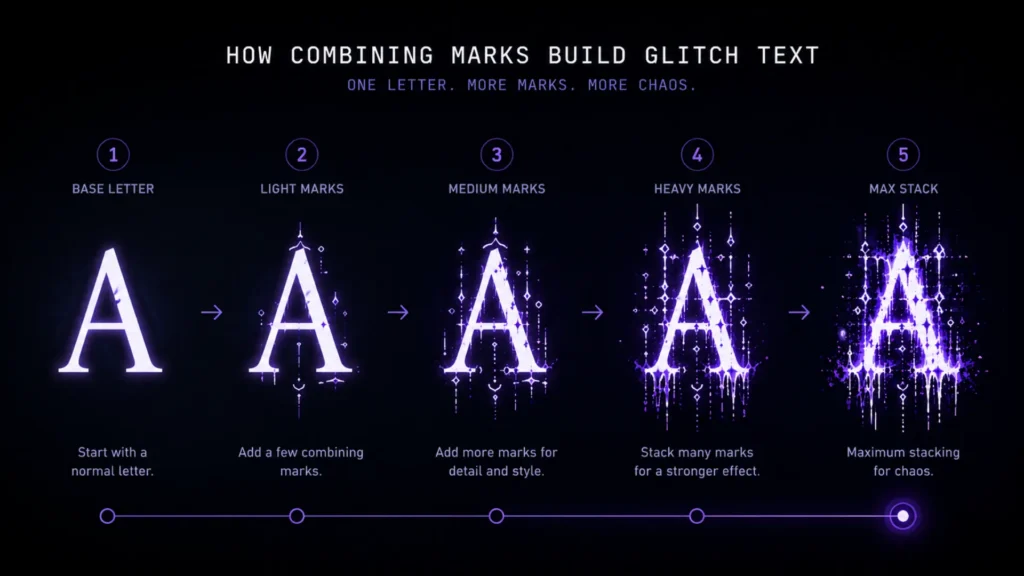
A combining character isn’t a standalone letter. It attaches to whichever character comes directly before it, positioning itself above, below, or straight through that letter. One mark produces a normally accented character. Stack ten, twenty, or forty marks on the same letter, and you get the jagged, overflowing look people associate with glitch text, because the Unicode standard never set a hard limit on how many marks can attach to a single character.
How the Effect Gets Generated
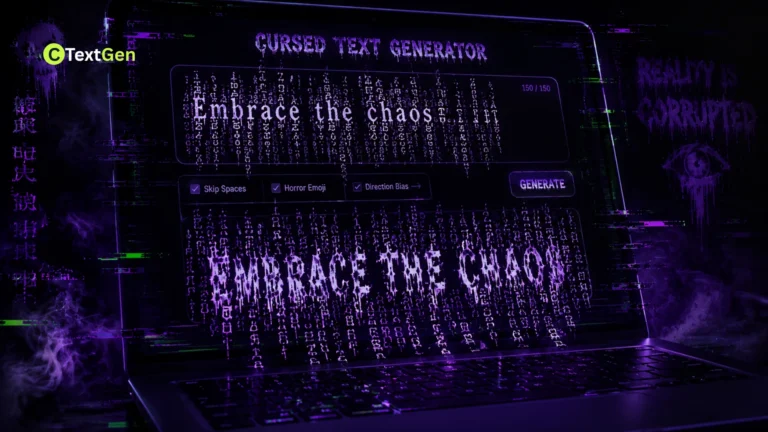
- You type a word or phrase into a generator.
- The tool takes each character and inserts one or more randomly selected combining marks immediately after it in the underlying text.
- Your device’s font rendering engine reads those combining marks and positions them relative to the base letter, exactly as it would with a normal accent.
- The more marks attached, the taller and more chaotic the letter looks, since each one adds another layer stacking above or below the last.
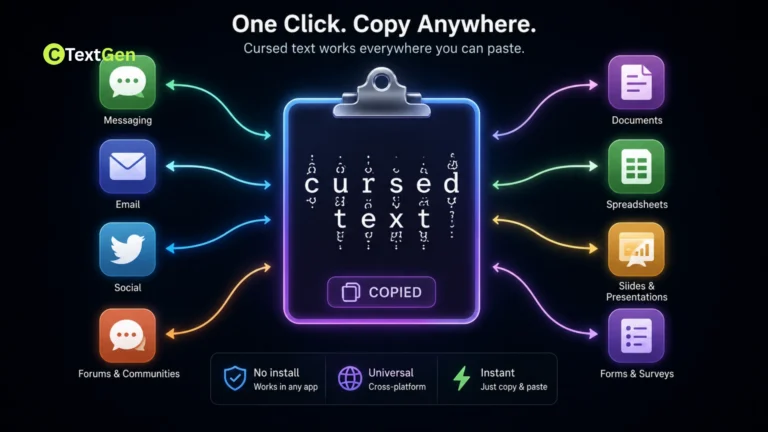
- The final result is copied as plain Unicode text, meaning it can be pasted into any text field that accepts standard characters, no special font or app required.
Why Some Apps Strip or Break It
Because there’s no cap on how many marks can stack, extremely dense glitch text can cause real rendering problems. Some browsers and older devices lag while trying to draw dozens of overlapping marks per character. Certain platforms, especially usernames, SMS gateways, and strict form fields, normalize or strip Unicode input specifically to prevent this, which is why heavy glitch text sometimes gets cut down or rejected entirely even when it’s copied over correctly. Posts and comments on platforms like Reddit and Discord usually preserve it fine, but always test before relying on it in an important context.
Where Glitch Text Actually Gets Used
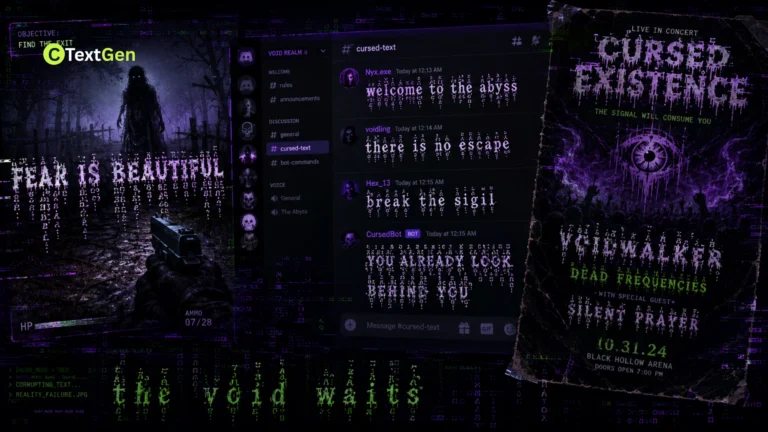
What is glitch text, and why is it popular? Look at how creators use it in social media bios, gaming usernames, and horror content.
- Gaming usernames and clan tags, especially in titles like Minecraft, Roblox, and Valorant, where a distorted name signals an edgy or intimidating vibe.
- Horror and creepypasta content, including story titles, Discord server names, and Halloween-themed captions.
- Cyberpunk and hacker aesthetics, where lighter glitch styling suggests a corrupted signal or a system breach rather than horror.
- Social media bios and captions on platforms like Instagram and TikTok typically use restrained intensity so the text stays legible within character limits.
- Music and album art, particularly in electronic and industrial genres, where visual distortion matches the sound.
Practical Examples of Glitch Text Intensity
- Subtle glitch: a couple of marks per letter, giving text a slightly rough, static-like edge while staying easy to read at a glance.
- Moderate glitch: marks above and below most letters, clearly stylized but still fully legible, common for usernames and bios.
- Heavy glitch or full Zalgo: dense stacks that push letters well beyond their normal line height, prioritizing visual chaos over readability.
Tips for Using Glitch Text Effectively
- Match intensity to the platform. Light glitch works well in BIOS, usernames, and comments. Heavy distortion is better reserved for standalone titles or images.
- Keep phrases short. A word or short phrase remains clear even at higher intensity, while full sentences quickly become visual noise.
- Preview before publishing. Rendering varies between apps and devices, so what looks clean in a generator can display differently once posted.
- Save a plain-text backup. If a platform strips the combining marks, you’ll want the original wording ready to paste again.
Common Mistakes to Avoid
- Using it in long-form writing. Glitch text across a full paragraph is genuinely hard to read and can look like spam rather than intentional styling.
- Assuming it’s a font. It’s plain Unicode text with extra characters attached, not a font file, so results can vary between apps and devices.
- Ignoring accessibility. Screen readers often announce the base letter plus every attached mark individually, which makes glitch text a poor choice for navigation menus, legal text, or anything meant to be read aloud.
- Overloading form fields. Extremely dense glitch text has occasionally caused layout issues in poorly coded input fields, which is why some platforms filter or reject it outright.
Frequently Asked Questions
What is glitch text? Is it the same thing as Zalgo text?
They use the same underlying Unicode mechanism, but glitch text usually refers to a lighter, more readable level of distortion. In contrast, Zalgo text pushes the marks to their most extreme, overflowing form.
Can glitch text damage my device or account?
No. It’s plain Unicode text, not code or a script, so it can’t execute anything harmful. The main risks are readability issues and occasional rejection by strict input fields, not security.
Does glitch text work on every platform?
Most of the time, it’s built from standard Unicode rather than a custom font. That said, usernames, SMS, and some form fields often strip or normalize combining marks, so heavy glitch text may not survive in all contexts.
Why do some letters look more distorted than others in the same phrase?
Most generators assign combining marks randomly to each character, so the exact placement and number of marks per letter vary even within a single word.
Who actually created glitch text?
There’s no single named creator. The style grew out of a 2004 Something Awful forum joke referencing an entity called Zalgo, and it later evolved into the broader “glitch text” naming as lighter, more versatile versions spread across gaming and social platforms. A helpful discussion on how people first encounter and reproduce this effect can be found in this Reddit thread on getting the weird glitch text look.
Conclusion
Glitch text turns an obscure corner of the Unicode standard into one of the internet’s most recognizable visual tricks. It isn’t a real glitch, a special font, or an image, just characters combining to do exactly what they were designed to do, stacked far beyond their original purpose. What is glitch text? Its roots are in the Zalgo creepypasta, and the mechanics behind how it’s made mean it stops looking like internet magic. It becomes something you can use deliberately, whether that’s a horror caption, a cyberpunk username, or a bio that needs a little extra edge.