Cursed Text vs Glitch Text vs Zalgo vs Corrupted Text
Four different names, one underlying trick, and endless confusion. People use cursed text, glitch text, Zalgo text, and corrupted text as if they’re perfect synonyms, and generator websites don’t help, since most of them slap all four labels on the same tool without explaining why.
They’re related, but they’re not the same thing, and the differences actually matter once you’re trying to pick the right style for a username, a horror caption, or a design project. This comparison breaks down cursed text vs glitch text, Zalgo vs glitch text, and the difference between cursed and corrupted text, using clear criteria instead of vague vibes.
The Quick Answer
Here’s the short version before the full breakdown:
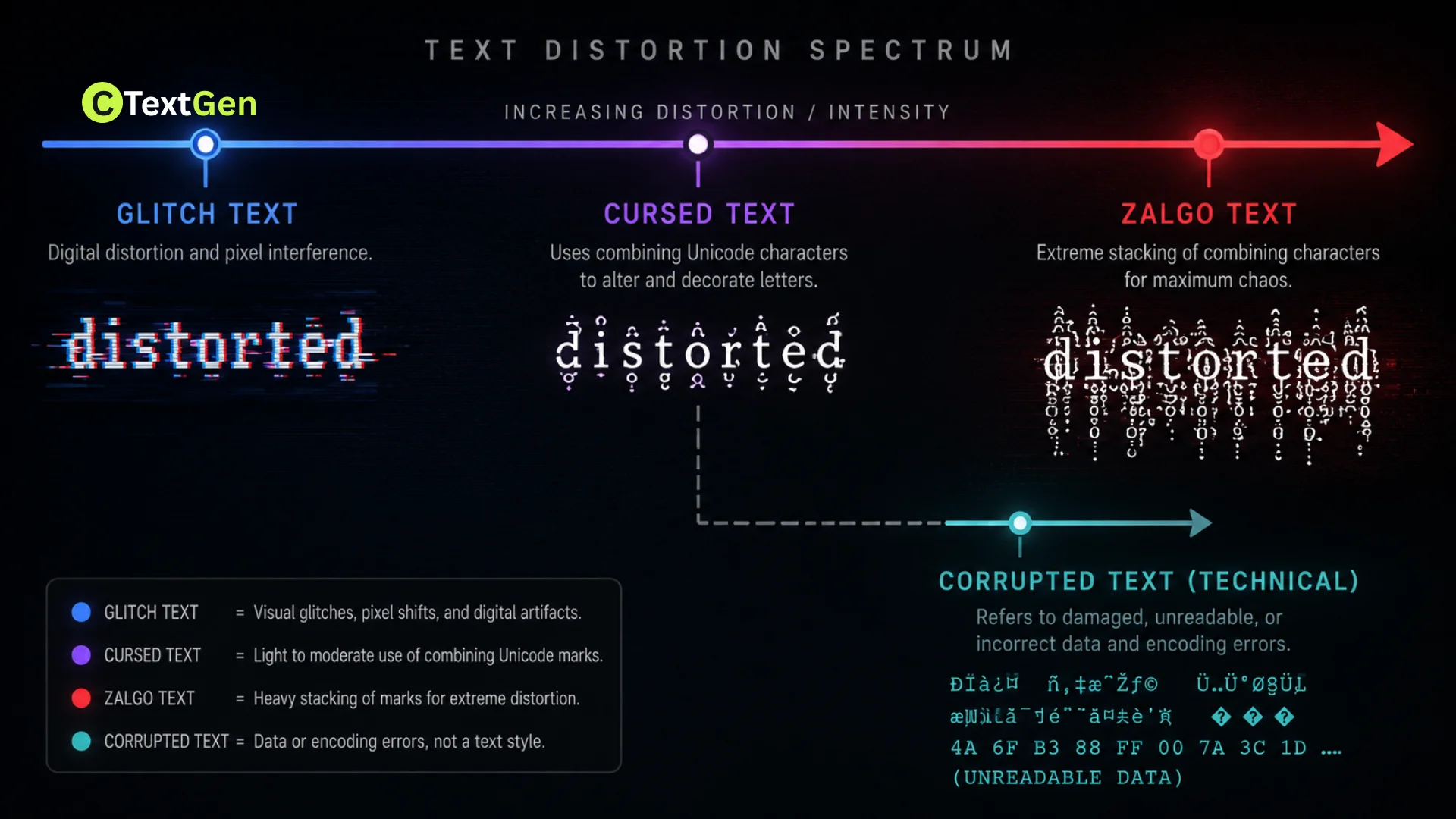
- Zalgo text is the original, most extreme version, where letters visually overflow their line height.
- Glitch text is a lighter, more restrained version of the same effect, jagged but still readable.
- Cursed text is the broadest umbrella term, covering both of the above plus other unsettling text styles.
- Corrupted text has two separate meanings: it’s sometimes used to describe the heaviest decorative distortion, and, separately, it describes real technical encoding errors that have nothing to do with any of the other three.
All four terms overlap heavily in casual use, but only one of them, corrupted text, actually splits into two genuinely different concepts depending on context.
What Each Term Actually Means
Before comparing them directly, it helps to define each one on its own terms.
Cursed Text
Cursed text is internet slang for writing deliberately styled to look strange, broken, or unsettling, usually through Unicode distortion. The word “cursed” here doesn’t mean literally supernatural. It comes from the broader “cursed images” trend that took off around 2016, in which surreal or off-putting photos were tagged as cursed. Cursed text borrowed that same label because it produces a similar reaction: something about it feels wrong, even if you can’t immediately explain why.
Glitch Text
Glitch text usually refers to a moderate level of distortion, enough to look jagged and digitally corrupted while staying fully readable. It leans into a “broken screen” or “corrupted signal” aesthetic rather than pure horror, making it a common choice for cyberpunk, hacker, and sci-fi-styled content, not just spooky captions.
Zalgo Text
Zalgo text is the most extreme and the oldest of the four, tracing back to a 2004 Something Awful forum joke about a fictional, world-consuming entity called Zalgo. It pushes the same underlying technique to its limit, stacking enough characters onto each letter that the text visually drips and overflows across multiple lines.
Corrupted Text
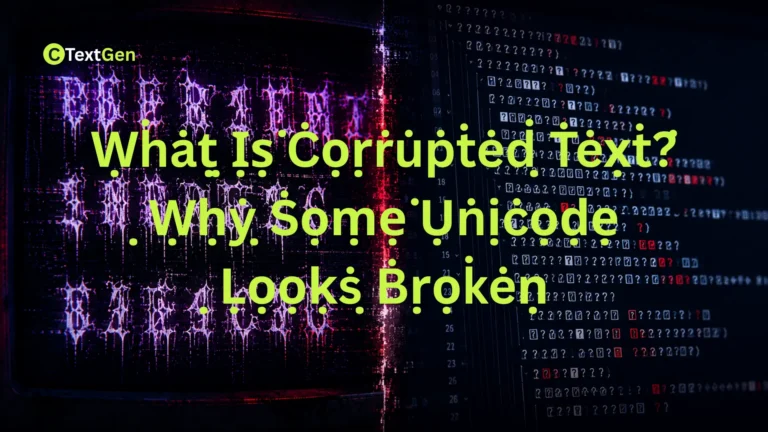
Corrupted text is where things genuinely split. In casual internet use, it often just means the heaviest, most chaotic version of decorative distortion, functionally similar to Zalgo. But in a technical context, corrupted text refers to mojibake, garbled characters that appear when a file or message gets read using the wrong character encoding. That version has nothing to do with horror memes or aesthetics. It’s a real data-handling problem.
Cursed Text vs Glitch Text
“Cursed Text vs Glitch Text” is the comparison people search for most often, and the core difference comes down to scope and intensity.
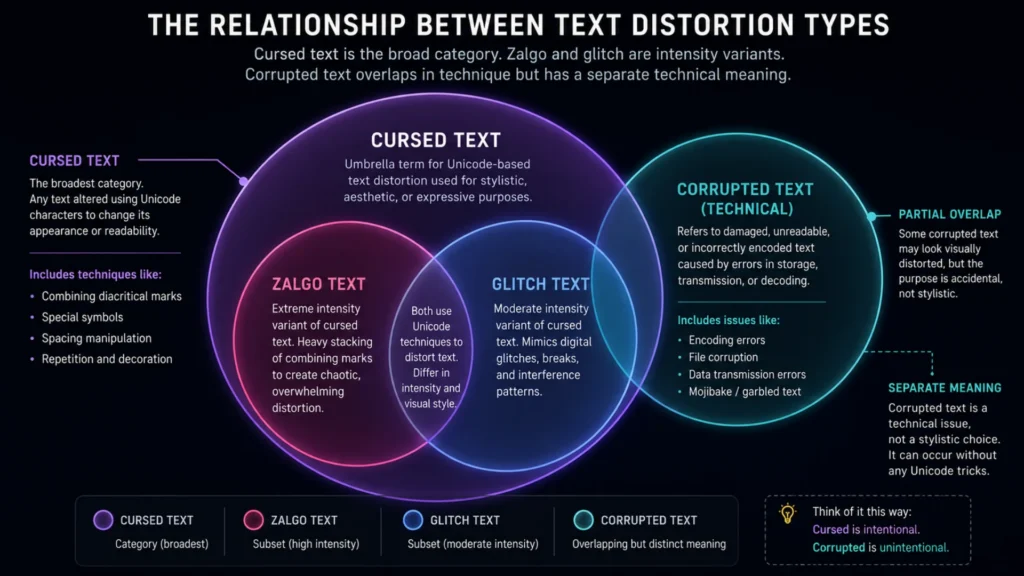
Cursed text is the umbrella category. It includes glitch text, Zalgo text, and other distortion styles, tied together by the general internet slang meaning of “cursed” as something strange or off-putting. Glitch text is one specific style within that umbrella, generally lighter and more legible, associated with a digital or technological aesthetic rather than a horror one.
Practically speaking, if you want text that still reads clearly at a glance but looks intentionally distorted, that’s glitch text. If you’re after something broader, whether it’s light distortion or full chaos, “cursed text” is the term that covers the whole range.
Zalgo vs Glitch Text
This pairing is really about intensity, since both styles are generated in the same way.
Zalgo text stacks dozens of Unicode combining characters onto each letter, producing text that overflows well past its normal line height, closer to visual noise than readable writing. Glitch text uses far fewer combining marks per letter, enough to look jagged and digitally distorted without sacrificing readability.
Think of it as a dial rather than a category difference. Turn the intensity down, and you get glitch text. Turn it all the way up, and you get Zalgo text. The mechanism underneath never changes.
Difference Between Cursed and Corrupted Text
This is the pairing where most explanations online fall apart, because corrupted text genuinely means two different things depending on who’s using it.
In the decorative sense, corrupted text and cursed text overlap almost completely. Someone describing a heavily distorted username as “corrupted” usually means the same thing as calling it “cursed,” just with a slightly more technical-sounding word.
In the technical sense, corrupted text refers to mojibake: garbled symbols, question marks, or empty boxes that appear when text is read with the wrong character encoding, such as a file written in UTF-8 but opened using Latin-1. That kind of corruption isn’t decorative at all. It’s an accident, usually caused by mismatched encoding settings between the system that created a file and the system reading it, and it can affect anything from an exported spreadsheet to an email subject line.
Cursed text is never accidental. It’s built on purpose, using the same Unicode combining characters as glitch and Zalgo text. Technically corrupted text is the opposite: unintentional, caused by software misinterpreting perfectly normal data.
The Shared Technology Behind Three of the Four
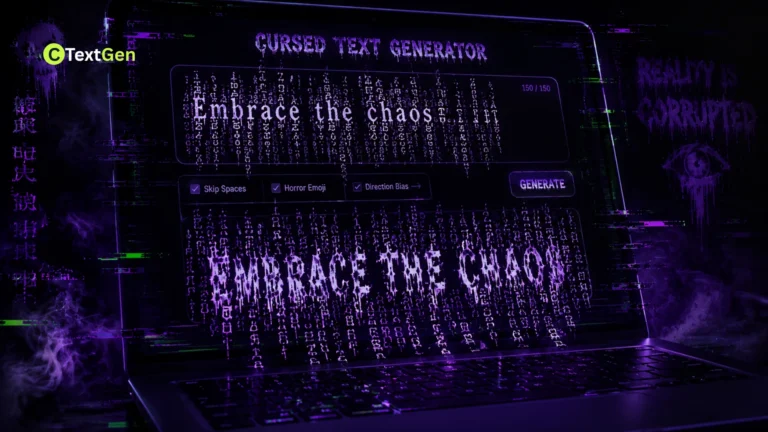
Cursed text, glitch text, and Zalgo text all rely on the same mechanism: Unicode combining diacritical marks, a set of characters mainly found in the range U+0300 to U+036F, normally used for ordinary accents like the one in “café.” A combining mark attaches to whichever letter comes directly before it. One mark creates a standard accented letter. Dozens create the distorted, stacked look shared by all three styles.
The only variable between them is quantity and placement. Light stacking reads as glitch text. Heavy stacking reads as Zalgo text. Cursed text is simply the name for the whole category, regardless of intensity.
Decorative corrupted text uses this same mechanism. Technical corruption, mojibake, uses none of it. It’s purely a mismatch between how one system wrote a piece of text and how another system tried to read it back, governed by character encoding standards like UTF-8, UTF-16, and older regional encodings, rather than by combining characters at all.
Side-by-Side Comparison
| Term | Typical Intensity | Origin | Primary Use Case |
|---|---|---|---|
| Cursed text | Any (umbrella term) | 2016-era “cursed images” slang | General unsettling or absurd styling |
| Glitch text | Light to moderate | Grew from Zalgo, popularised separately | Cyberpunk, hacker, sci-fi aesthetics |
| Zalgo text | Heavy to extreme | 2004 Something Awful creepypasta | Horror content, creepypasta, maximal chaos |
| Corrupted text (decorative) | Heavy | Same roots as Zalgo | Interchangeable with heavy cursed/Zalgo text |
| Corrupted text (technical) | Not applicable | Character encoding mismatch | Software bugs, file handling, data recovery |
How to Choose Which One to Use
- Want something readable but visually edgy? Reach for glitch text.
- Want maximum chaos for a horror caption or creepypasta title? Use Zalgo text.
- Not sure which intensity you want, or need a general term to search for? “Cursed text” covers the full range and is the most commonly searched term of the four.
- Seeing garbled symbols in a file or email you didn’t create yourself? That’s very likely technically corrupted text, a fixable encoding issue, not a decorative style at all.
Practical Examples
- Glitch text example: a username with light distortion, readable but clearly stylized, fitting a cyberpunk Discord server.
- Zalgo text example: a creepypasta title stacked so heavily that the letters bleed several lines above and below the text, meant to unsettle before the story even starts.
- Cursed text example: any of the above, used loosely as a catch-all description in casual conversation.
- Technical corrupted text example: an exported CSV file showing “México” instead of “México” because it was opened with the wrong encoding.
Tips for Using These Styles Well
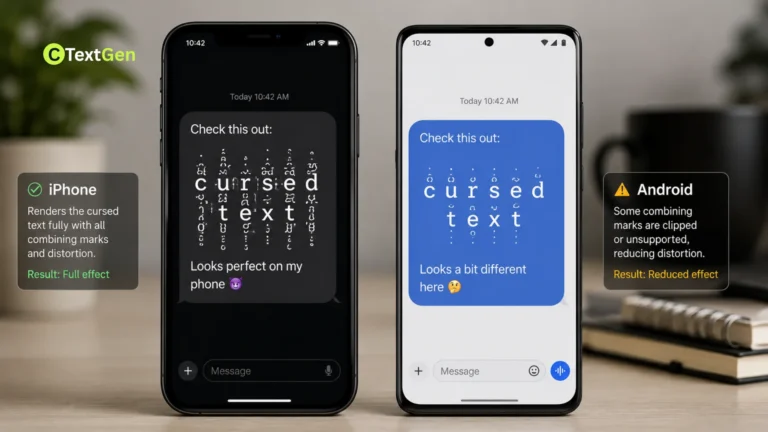
- Match intensity to platform. Heavy Zalgo text often gets clipped or slows rendering in bios, comments, and character-limited fields, while lighter glitch text holds up better across more apps.
- Use the umbrella term when searching for tools. Most generators respond better to “cursed text generator” as a search term than to more specific labels, since it’s the most widely used name.
- Don’t confuse a real encoding bug with a style choice. If text looks garbled in a file you didn’t intentionally distort, check the file’s character encoding before assuming anything is permanently broken.
- Test before publishing. Rendering varies across devices, so preview any heavily stacked text on the actual platform you plan to use.
Common Mistakes to Avoid
- Treating all four terms as perfect synonyms. They overlap, but “corrupted text” specifically carries a technical meaning that the other three don’t share.
- Assuming heavy distortion works everywhere. Extremely dense Zalgo-style text causes lag or gets truncated on older devices and in strict input fields.
- Ignoring accessibility. Screen readers struggle with dense combining marks regardless of which name you’re using for the effect, so keep it out of navigation and anything meant to be read aloud.
- Panicking over technically corrupted text. Mojibake almost always means the original data is intact and needs the correct encoding, not that anything was lost.
Frequently Asked Questions
Which term should I actually search for if I want a text generator?
“Cursed text generator” tends to return the widest range of tools and intensity options, since it’s the broadest and most commonly used term, while “Zalgo” and “glitch text” searches sometimes return more narrowly focused results.
Does the intensity of the distortion affect how well text performs on social media?
Yes. Heavier distortion is more likely to get trimmed by character limits or filtered by platforms that restrict Unicode input, so lighter glitch-style text generally performs more reliably in bios and captions.
Is corrupted text ever used as a deliberate design choice outside of its use in internet slang?
Rarely, and when it is, it almost always refers to the decorative, Zalgo-adjacent meaning rather than the technical encoding sense, since intentionally corrupting encoding would make a file unreadable rather than stylish.
Can mixing these styles in one caption cause problems?
Combining heavy Zalgo-level distortion with already limited character counts, like an Instagram bio, can cause text to get cut off mid-word, so it’s worth testing shorter, lighter versions first.
Where can I read more about how the original Zalgo style developed?
The Wikipedia entry on Zalgo text documents its 2004 origin and spread in detail and remains one of the more reliably sourced references on the topic.
Conclusion
Cursed text, glitch text, Zalgo text, and corrupted text all trace back to the same small trick: stacking Unicode combining characters past their intended use. The differences between them come down to intensity and context, not separate technologies, with one major exception. Corrupted text carries a second, entirely technical meaning that has nothing to do with horror memes or internet aesthetics. Once you know where each term actually sits on that spectrum, choosing between cursed text vs glitch text, or telling Zalgo vs glitch text apart at a glance, stops being guesswork.