Is Cursed Text a Font? The Real Truth About Its Characters
Someone in a fan fiction comment section asks how to “write in that cursed font.” A Discord user calls their glitchy username “my cursed font.” Even generator websites sometimes label their tool a font converter. The word gets used constantly, and almost none of it is technically accurate.
Is Cursed Text a font? The short answer is no. Understanding why clears up a lot of confusion about how this effect actually works, what characters used in cursed text are doing the heavy lifting, and why the same “font” can look completely different depending on where you paste it. This article settles the question properly and explains the underlying mechanics.
Is Cursed Text a Font? The Short Answer
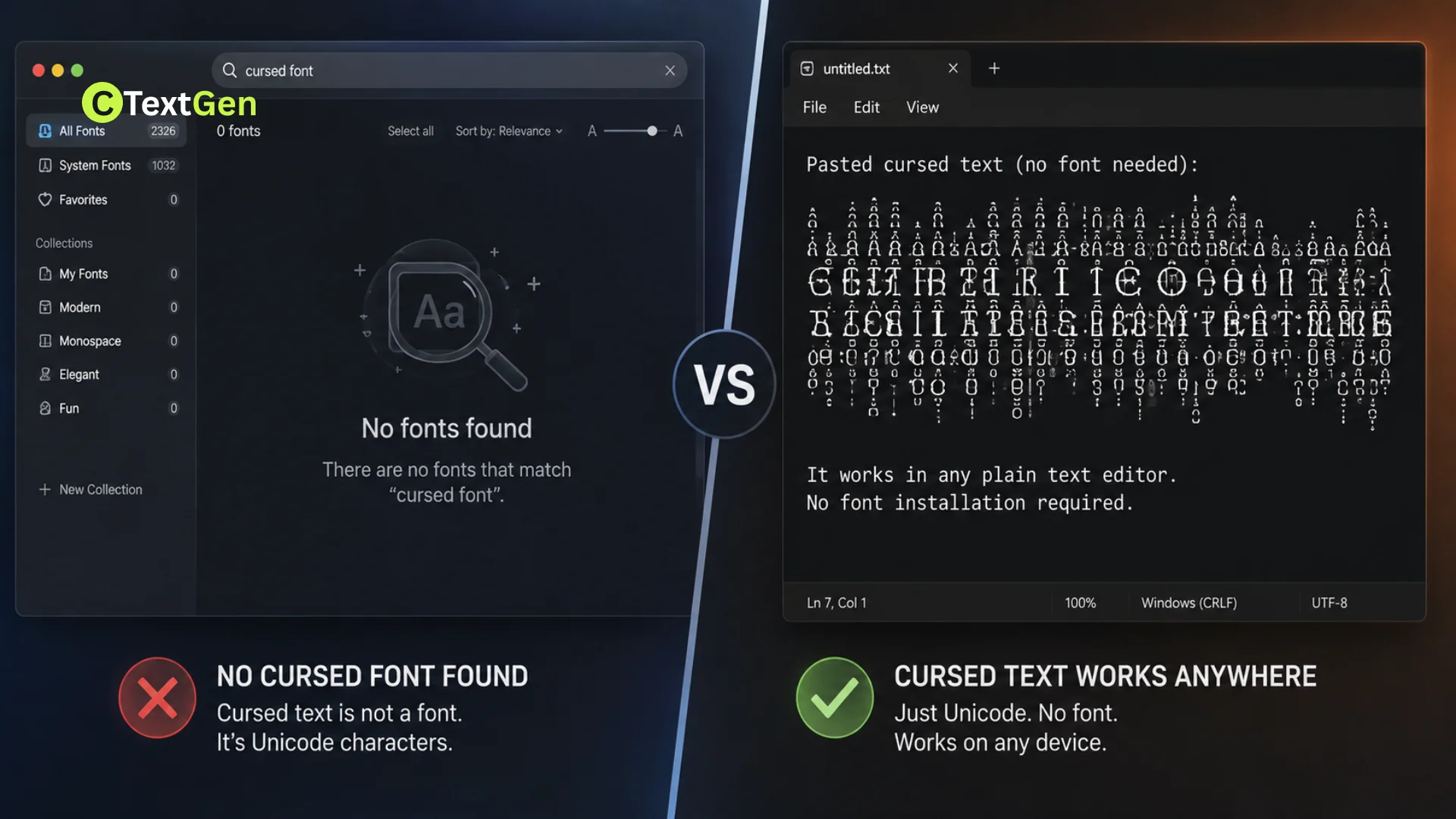
Is Cursed Text a Font? No. Cursed text is not a font. It’s plain Unicode text, made of real letters with extra characters attached. A font is a separate file installed on a device that tells software how to render each character visually. Cursed text needs no installation and no font file at all. It works because of which characters are present in the text itself, not because of how any particular font renders them.
That distinction matters more than it might seem, because it explains nearly every quirk people run into with cursed text: why it sometimes looks different across apps, why it can be typed on any device, and why searching your font manager for “cursed font” never turns up anything.
What Cursed Text Actually Is, If Not a Font
Is Cursed Text a font? It helps to separate two things that get lumped together constantly: fonts and text
Font vs Unicode Text
Is Cursed Text a font? It helps to realize that fonts are installed files (.ttf or .otf) containing glyphs, whereas cursed text is built directly into Unicode characters.
A font is a file, typically in a format like TrueType (.ttf) or OpenType (.otf), containing a set of glyphs, the visual shapes used to draw each character. Installing a font adds those shapes to your device so that software can use them. Changing a font changes how existing text looks, but it never changes what the text actually is.
Cursed text works at a completely different layer. It doesn’t touch glyph design at all. Instead, it changes which characters are present in the text itself, layering extra Unicode characters onto ordinary letters. Your device then renders those characters using whatever font is already active, the same font you’d use for any other text on that app or website.
This is exactly why cursed text can be copied and pasted anywhere that accepts plain text, from a text message to a spreadsheet cell, without you ever installing anything. A real font can’t do that. If you don’t have the font installed, text that’s meant to use it will either fall back to a default font or display incorrectly.
What Characters Does Cursed Text Actually Use
This is the part most generator sites gloss over, and it’s the actual mechanism behind the entire effect.
Unicode Combining Diacritical Marks
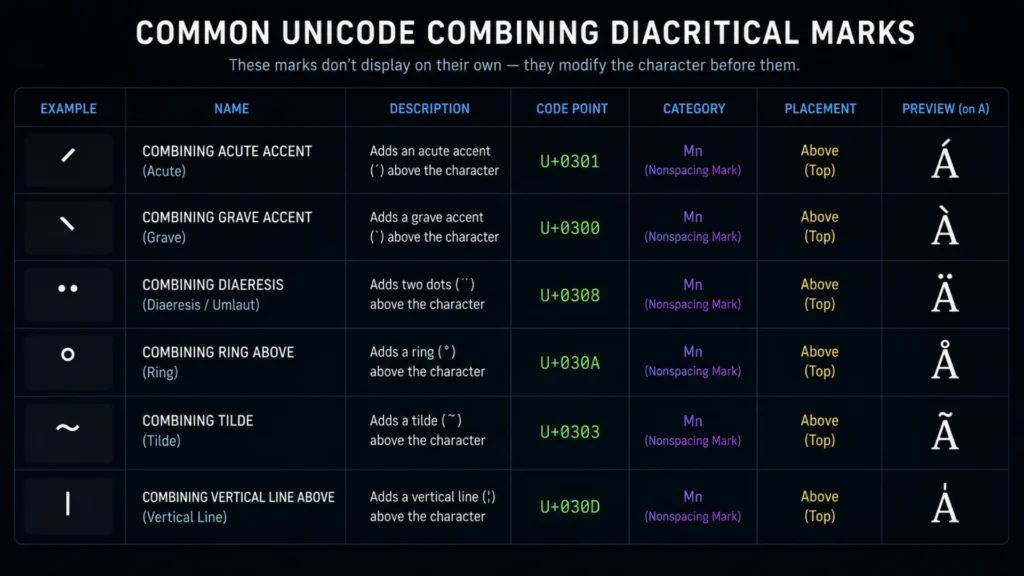
Is Cursed Text a font? People often stumble across combinations of diacritical marks without realizing what they are. Cursed text is built from a specific category of Unicode characters called combining diacritical marks, found mainly in the block spanning U+0300 to U+036F. These are the same category of characters used for ordinary accents in real languages. A few examples of individual marks in this range:
- U+0300, COMBINING GRAVE ACCENT: the mark that creates the accent in “è.”
- U+0301, COMBINING ACUTE ACCENT: the mark used in “é.”
- U+0303, COMBINING TILDE: the mark used in “ñ.”
- U+0308, COMBINING DIAERESIS: the mark used in “ö.”
- U+0333, COMBINING DOUBLE LOW LINE: a mark that draws a double underline beneath a character.
- U+0335, COMBINING SHORT STROKE OVERLAY: a mark that draws a short horizontal line directly through a character.
None of these is an unusual or secret character. They’re standard parts of the Unicode Standard, used every day in French, Spanish, Vietnamese, and dozens of other languages for entirely ordinary spelling.
How These Characters Combine to Create the Cursed Look
This stacking mechanism is the main technical reason why asking if “cursed text” is a font yields a strict “no” from developers and typographers. A combining character isn’t a letter on its own. It attaches to whatever character comes directly before it in the text, positioning itself above, below, or through that base letter. One combining mark produces a normally accented letter. The trick behind cursed text is that Unicode never placed a hard limit on how many combining marks can attach to a single character.
The Cursed text generator takes advantage of that gap. Instead of adding one mark per letter, they insert dozens of marks across the full combining marks block and stacks them all onto the same base character. The result is letters that appear to stretch, drip, and overflow their line height, built entirely from legitimate Unicode characters used far beyond their typical purpose.
Cursed Font Meaning & Why People Call It a Font
If cursed text isn’t a font, why does everyone, including some generator websites, call it one? Mostly because “font” has become informal shorthand for “any way text can look different.” In casual conversation, people say “font” the way they might say “style,” even when the actual mechanism has nothing to do with typography in the technical sense.
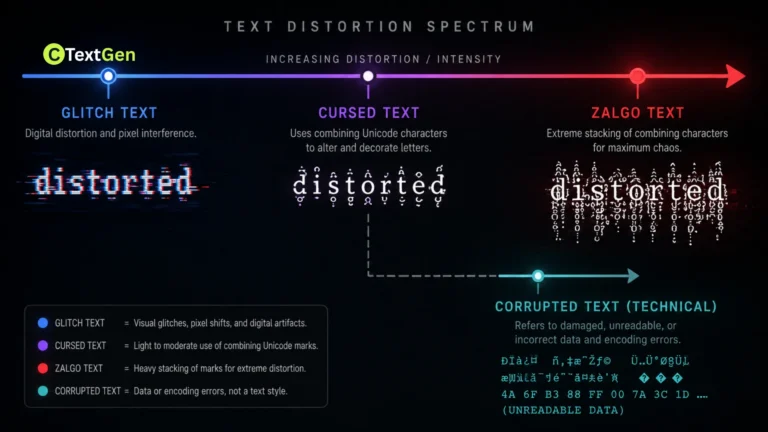
This isn’t unique to cursed text. People commonly describe bold Unicode letters, small caps text, and upside-down text generators as “fonts” too, even though they all work through the same substitution trick: swapping standard letters for different Unicode characters that happen to look stylized, rather than changing any actual font file. The meaning of “cursed font” in everyday use is really just “text that looks different from normal,” even though the technical process is character substitution, not font rendering.
Glitch Font Explained
Is Cursed Text a font? It’s actually confusing Unicode-based Zalgo text with downloadable glitch typefaces.
Here’s where it gets genuinely interesting, and where most articles get sloppy: unlike cursed text, some things actually marketed as “glitch fonts” are real, installable fonts.
Design marketplaces sell TrueType and OpenType font files named things like “Glitch Sans” or “Corrupted Display,” featuring letterforms that are permanently distorted, jagged, or fragmented as part of their static design. These are genuine fonts. They need to be downloaded and installed; they only work in software that supports custom font installation, such as Photoshop or a design tool, and the distortion is baked into the letter shapes themselves rather than created by stacking Unicode characters.
That’s a real, important distinction:
- A downloadable glitch font is a static design file with permanently distorted letterforms, used in graphic design, posters, and branding.
- Cursed or Zalgo text is generated by stacking Unicode combining characters onto ordinary letters, works in any plain text field, and requires no installation at all.
Both can look chaotic and unsettling. Only one of them is technically a font.
How to Tell Which One You’re Dealing With
Is Cursed Text a font or a real typography file? A quick practical test settles the question almost instantly. Try selecting the text character by character with your cursor. If it’s cursed text, you’ll notice the selection grows unevenly, since each visible “letter” is actually several stacked Unicode characters. If it’s a real glitch font, selecting a single letter selects exactly one character, just like normal text.
Another test: try pasting the text into a plain text editor, like Notepad or TextEdit, with formatting stripped. Cursed text will still display its distortion, since the effect lives inside the characters themselves. A styled font effect will disappear entirely, since plain text editors ignore custom fonts and fall back to a default typeface.
Practical Examples
- Cursed text example: typing “hello” into a generator produces a word where each letter is buried under multiple stacked combining marks, pasteable into any app without installing anything.
- Glitch font example: downloading a distorted typeface from a font marketplace and applying it to a poster headline in Photoshop, where the jagged look is part of the font’s fixed letter design.
- Testing example: pasting a suspected cursed text sample into Notepad. If the distortion survives, it’s Unicode-based; if it vanishes, it was a font effect that Notepad couldn’t apply.
Tips for Using Cursed Text Effectively
- Don’t search for a font file. If you ask, “Is cursed text a font?” because you’re looking for a file, you won’t find one; use a generator instead. Use a text generator instead, then copy and paste the result.
- Keep phrases short. Heavily stacked combining characters get unreadable fast across full sentences.
- Test on your target platform first. Some apps strip or limit combining marks, so preview before posting somewhere important.
- If you actually want a static distorted look for design work, search for a genuine glitch or distorted font on a type marketplace instead of a text generator, since that’s the tool actually built for that purpose.
Common Mistakes to Avoid
- Trying to install cursed text like a font. There’s no file to download, because the effect lives in the characters, not in a typeface.
- Assuming all “glitch fonts” work the same way. Some are real installable fonts with fixed letterforms; others are just cursed text generators using misleading marketing language.
- Overusing heavy distortion in long text. Dense combining marks across a full paragraph become genuinely hard to read.
- Ignoring accessibility. Screen readers often announce every stacked combining mark individually, which makes cursed text a poor choice for anything meant to be read aloud.
Frequently Asked Questions
Do I need to install anything to use cursed text?
No. Since cursed text is built from standard Unicode characters rather than a font file, you can generate it online and paste it directly into any app that accepts plain text, with nothing to download or install.
Will cursed text still look distorted if I paste it into Microsoft Word or Canva?
Yes, in most cases, since both accept Unicode text and will render whatever combining characters are present using the active font, though extremely dense text may still look different depending on that font’s rendering behavior.
Can search engines read or index cursed text normally?
Technically, yes, since it’s still text rather than an image, though the extra combining characters can make it harder for search engines to match against normal search queries, which is one reason it’s not recommended for page titles or headings meant to rank.
Is there a real font that looks like cursed text without needing all the extra characters?
Yes. Some type designers sell static “glitch” or “distorted” fonts with permanently broken-looking letterforms built into the design, which is a genuinely different product from a Unicode-based cursed text generator.
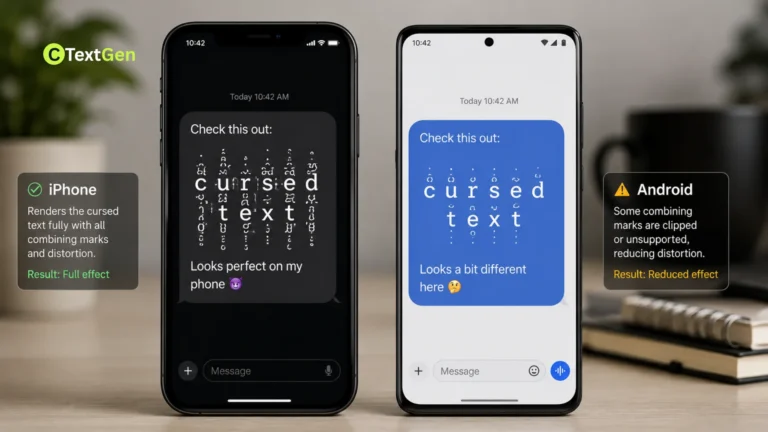
Why does my cursed text look fine on my phone but broken on my laptop?
This usually comes down to how each device’s font rendering engine handles a large number of stacked combining marks, since some systems cap or reflow dense character stacks differently than others. For a firsthand example of people working through exactly this kind of confusion, this Reddit thread on writing in “cursed font” for fan fiction is worth a look.
Conclusion
To summarise the debate over “is cursed text a font“, it borrows the language of typography without actually being typography. Cursed text borrows the language of typography without actually being typography. It’s built from real Unicode combining characters, stacked far beyond their intended purpose, not a font file waiting to be installed. Knowing what characters are actually used in cursed text, and understanding the real difference between that and a glitch font sold as a typeface, means you’ll never waste time hunting for a font file that was never going to exist in the first place.