What Is Zalgo Text? Mind-Blowing Secrets Behind the Most Chaotic Font
Somewhere between a horror meme and a keyboard trick, Zalgo text has been unsettling people online for over two decades. You’ve probably seen it: a word where every letter drips with tiny marks stretching above and below the line, looking like it’s about to crawl off the screen. It shows up in Discord bios, creepypasta titles, and the occasional message that makes your phone lag for no obvious reason.
This article explains what Zalgo text is in plain terms, covers the real origin of Zalgo text, explains who Zalgo is in the mythological sense, and breaks down why it looks the way it does. It also covers something most competing pages skip entirely: the documented cases where this “just a font trick” actually crashed phones and email inboxes.
What Is Zalgo Text
Zalgo text is digital text modified with a heavy stack of Unicode combining characters, the small marks normally used for accents, so that letters appear distorted, glitchy, or corrupted. It’s also commonly known as cursed text or glitch text, and the goal is to make ordinary writing look frightening or broken.
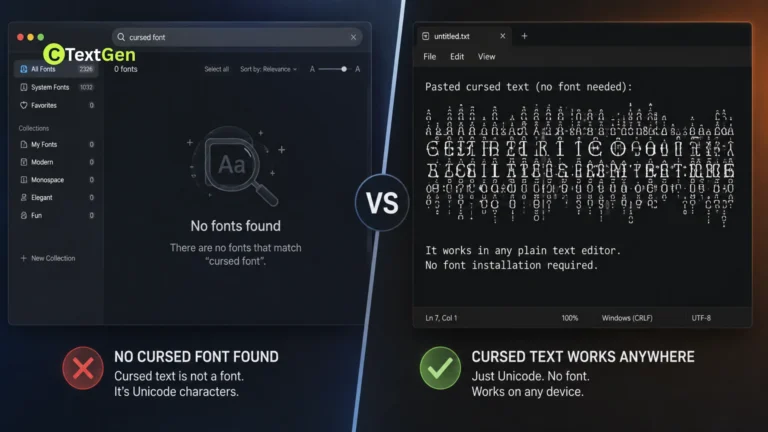
It isn’t a downloadable font. It isn’t an image. Every letter you see is a real character, just buried under dozens of extra symbols attached to it. That’s the whole trick, and it’s also why Zalgo text can be typed, copied, and pasted almost anywhere a keyboard works, though extreme symbol density leaves people asking if cursed text can break your device or crash system memory.
The Origin of Zalgo Text
The origin of Zalgo text is more specific and better documented than most internet memes get credit for.
Who Is Zalgo
Zalgo text was pioneered in 2004 by a member of the Something Awful forums who created image macros of glitched, distorted cartoon characters exclaiming “Zalgo!” The characters in these edited comics were often shown bleeding from their eyes, and forum members began interpreting Zalgo as an unimaginable, apocalyptic figure tied to eldritch horror.
So who is Zalgo, exactly? There’s no single canonical answer, which is part of what made the mythology spread. Fans have described Zalgo as an unseen supernatural force, a hidden cabal, or something closer to a fallen god, frequently compared to the Great Old Ones from H. P. Lovecraft’s cosmic horror fiction. The lack of a fixed explanation gave the community room to keep building on the idea for years, through fan art, short films, and creepypasta writing.
From Forum Joke to Named Meme
The distorted lettering used in those original comic edits became popularised as “Zalgo text.” What started as a specific joke about a handful of edited comic panels eventually detached from the original images entirely. Once the visual style had a name, anyone could apply it to any text, and the format spread across horror forums and early social media independent of the comics that started it.
The Meaning Behind Zalgo Text’s Popularity
Understanding the meaning of Zalgo text requires looking past its horror roots, because the format has grown into something broader than a scary meme.
Historically, Zalgo text has been used primarily in horror and creepypasta content, and its glitched, improperly rendered appearance made it a natural fit for memes designed to make a reader’s device appear to be malfunctioning. More recently, it has become closely associated with “surreal meme” culture, a style of humor built around bizarre, absurd imagery that intentionally avoids referencing real people or brands. In that context, Zalgo text works as a kind of visual punchline. It signals “something here is deliberately wrong,” fitting neatly alongside other surreal-meme staples like clip art and recurring nonsense characters.
That dual identity, as both a horror trope and an absurdist meme format, is a big part of why Zalgo text has outlasted most internet fads from the same era.
How Zalgo Text Actually Works
This is the part most horror-focused articles gloss over, so here’s the real mechanism.
The Unicode Combining Characters Behind the Effect
Zalgo text is built from Unicode’s combining diacritical marks, a set of characters mostly living in the range U+0300 to U+036F. These marks exist for entirely ordinary reasons. They’re what put the accent on “café” or the tilde on “jalapeño.” A combining mark doesn’t work as a standalone letter. It attaches to whatever character comes directly before it, positioning itself above, below, or straight through that base letter.
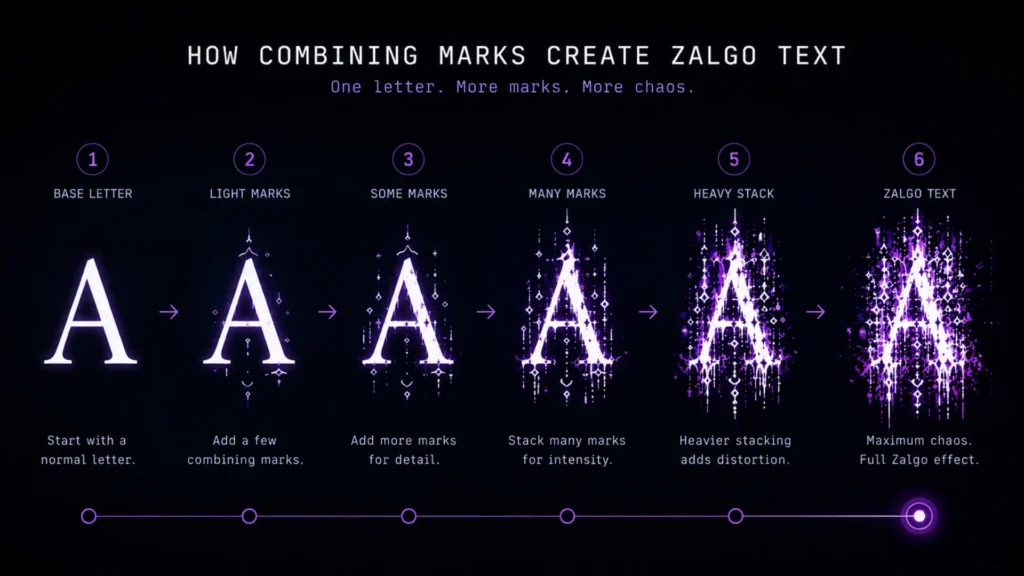
Generators create the Zalgo effect by attaching far more combining marks to each letter than any real language ever would, often dozens per character. Since Unicode never set a hard limit on how many marks can stack onto one letter, the result piles upward and downward until the text visually overflows its own line.
How the Distortion Gets Built
- You type a word or phrase into a cursed text generator.
- The tool inserts a randomized set of combining marks directly after each character in the underlying text.
- Your device’s font rendering engine reads those marks and stacks them relative to the base letter, exactly the way it would render a normal accent.
- The more marks attached, the further the letter stretches above and below the line.
- The output copies as plain Unicode text, so it works in almost any app that accepts standard characters; no special font is required.
When Zalgo Text Actually Broke Things
Here’s something almost no generator website mentions, and it’s genuinely important context: Zalgo text has caused real technical problems, not just visual ones.
Some versions of Apple’s Messages app could not properly handle Zalgo text and would crash when trying to render a message containing it, a flaw that was exploited to carry out denial-of-service attacks against iOS users. Similarly, Zalgo messages sent through Gmail have caused crashes on the receiving end.
These incidents happened because rendering engines aren’t built to expect dozens of stacked combining marks on a single character. What looks like a stylistic joke to a human reader can force certain apps to do an enormous amount of unexpected rendering work, and older or poorly optimized software sometimes fails under that load. It’s a good reminder that Zalgo text, while harmless in casual use, isn’t purely decorative from a technical standpoint.
Zalgo Text in Pop Culture
A fan-made campaign logo associated with Michael Bloomberg’s 2020 presidential campaign, initially mistaken for an official design, was widely described as closely resembling Zalgo text. In 2020, a TikTok creator submitted the word “hamburger” written in Zalgo text as his high school yearbook caption, and when the yearbook was printed, the distorted text overlapped both his photo and the photo of the student below him.
The style has also influenced other glitch art projects. Performance artist Laimonas Zakas cited Zalgo text as inspiration for Glitchr, a Facebook page built around intentionally corrupting and glitching Facebook’s own code. These examples show how far the format has traveled from its Something Awful origins, showing up in political commentary, yearbook pranks, and fine art without losing its original unsettling edge.
Zalgo Text vs Glitch Text vs Cursed Text
These three terms overlap constantly, and it’s worth knowing the actual distinctions:
- Zalgo text is the original, most extreme style, where combining marks stack heavily enough that letters overflow their line height entirely.
- Glitch text usually refers to a lighter, more restrained version of the same technique, jagged but still fully readable, often used for cyberpunk or hacker aesthetics rather than horror.
- Cursed text is the broadest umbrella term, covering Zalgo, glitch text, and other unsettling text styles, tied to the general internet slang meaning of “cursed” as something strange or off-putting.
All three rely on the same Unicode mechanism. The only real difference is intensity and the visual mood each one is going for.
Practical Examples of Zalgo Text
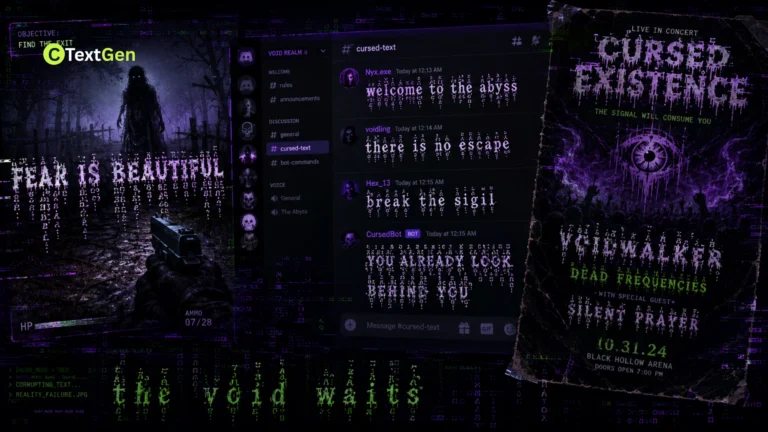
- Light distortion: a few marks per letter, giving text a subtly rough edge while staying easy to read, common in bios and captions.
- Moderate distortion: visibly jagged letters with marks above and below, still legible but clearly unsettling.
- Full Zalgo: dense stacks that push letters well past their normal line height, prioritizing chaos over readability, typically reserved for short phrases or titles.
Tips for Using Zalgo Text Responsibly
- Keep it short. A word or short phrase stays readable even at high intensity, while full sentences quickly become visual noise.
- Test before posting somewhere important. Rendering varies across apps, and given the documented crash incidents on some platforms, it’s worth previewing heavy Zalgo text before sending it to someone with an older device.
- Avoid it in accessibility-critical content. Screen readers can struggle badly with dense combining marks, so keep Zalgo text out of navigation, alt text, or anything meant to be read aloud.
- Save a plain-text backup. Some platforms strip combining marks entirely, so keep the original wording handy in case you need to repaste it.
Common Mistakes to Avoid
- Assuming it’s a real font. Zalgo text is plain Unicode with extra characters layered on, not a font file, so it can render differently across devices and apps.
- Sending extremely dense Zalgo text to unknown recipients. Given the documented history of crashes on certain messaging apps, this can come across as disruptive rather than funny.
- Using it in long-form writing. Heavy Zalgo text across a full paragraph becomes genuinely hard to read and can look like spam.
- Confusing Zalgo text with a virus. It’s just text. It can’t install anything or access your device beyond what any normal message would.
Frequently Asked Questions
Is Zalgo a real character from a comic or game?
No. Zalgo started as an internet-only creepypasta concept built around edited comic strips, and there’s no single official design or canonical story, which is part of why fan interpretations vary so widely.
Can Zalgo text actually crash my phone?
In most everyday cases, no. However, certain older versions of specific apps, including some iOS Messages builds and Gmail, have had documented issues rendering extremely dense Zalgo text, occasionally causing crashes.
Is Zalgo text the same as cursed text?
They’re closely related. Zalgo text refers specifically to the heavily stacked, extreme version of the effect, while cursed text is a broader term that also covers lighter distortion styles and other unsettling text tricks.
Why does Zalgo text look different on different apps?
Font rendering engines handle stacked Unicode combining marks differently, and some platforms cap or strip the marks entirely, which is why the same Zalgo text can look dramatically different depending on where it’s pasted.
Where can I read more discussion about how people encounter Zalgo text?
Community discussions, like this Reddit thread explaining what Zalgo text is on Discord, are a good place to see how everyday users first run into the format and figure out what it means.
Conclusion
Zalgo text turns a fairly obscure corner of the Unicode standard into one of the internet’s longest-running visual gags. It started in 2004 as a specific joke about a comic-devouring entity on the Something Awful forums, grew into a full creepypasta mythology, and eventually became shorthand for anything meant to look glitchy, broken, or bizarre. It’s also, somewhat surprisingly, caused actual crashes on real devices, which is more than most memes can claim. Once you understand the Zalgo text origin, who Zalgo actually represents in the lore, and the Unicode mechanics behind the effect, it stops being a random oddity and becomes a piece of internet history you can explain to anyone who asks.