Definitive Cursed Text Meaning and Origin
Understanding the “cursed text meaning” helps clarify why this distorted visual style has become so popular across forums, chat apps, and social media. That’s cursed text, and if you’ve ever wondered what it actually is or why it exists, you’re not alone. It’s one of those internet formats everyone has seen, but almost nobody can explain it on the spot.
This article explores the true meaning of cursed text, traces its origins, and explains the technology that makes it possible: no filler, no recycled definitions, just a genuinely useful breakdown.
What Is Cursed Text
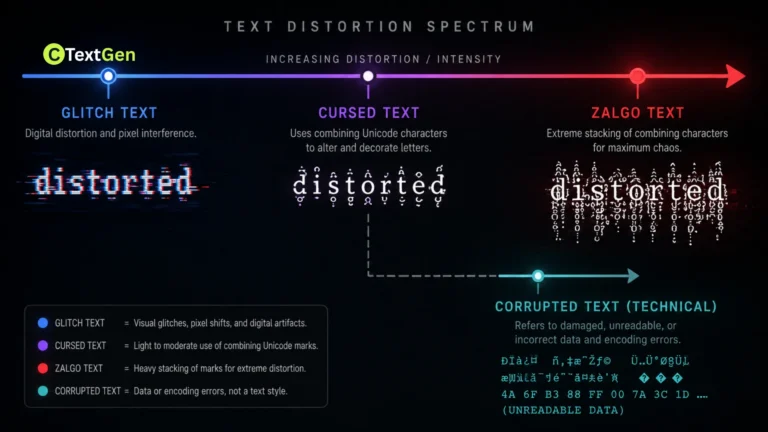
Cursed text is ordinary writing that’s been dressed up with extra Unicode symbols so it looks distorted, glitchy, or corrupted. Many users wonder if cursed text is a font, but it actually relies on special character combinations rather than a standard typeface file. You’ll also hear it called Zalgo text, glitch text, or demonic text, and people tend to use those names loosely, even though they don’t mean the same thing.
The “cursed” part comes from internet slang, not literal witchcraft. Online, calling something “cursed” means it feels strange or unsettling in a way that’s hard to put into words. That usage took off with the “cursed images” trend around 2016, when weird, badly lit, or nonsensical photos started getting tagged as cursed on Tumblr and Twitter. Cursed text picked up the same label because it produces a similar reaction. You see it, something feels wrong, and you can’t quite explain why.
How Cursed Text Differs From Zalgo Text
These two terms are treated as synonyms, but there’s a real difference worth knowing.
Zalgo text refers specifically to the original, most extreme style, where combining marks stack heavily above and below each letter until it looks like it’s bleeding off the screen. Cursed text is the wider umbrella. It includes Zalgo, but also lighter distortion styles, glitch effects, and other unsettling text tricks that don’t go nearly as far.
Every piece of Zalgo text counts as cursed text, but not every cursed text example is full Zalgo. Unpacking the cursed text’s meaning makes it easier to spot these subtle formatting differences, especially when checking if cursed text works on mobile devices without rendering errors.
The Origin of Cursed Text
The origin and cursed text meaning are not tied to some vague internet legend. It has a documented starting point, and it’s more specific than most people assume.
The 2004 Something Awful Creepypasta
In 2004, a member of the Something Awful forums began posting edited comic strips, mostly Nancy and Archie panels, where the dialogue and artwork looked increasingly warped and corrupted. The joke was that an unseen force called “Zalgo” was slowly consuming the comic itself. The distorted lettering in those posts became the visual signature of the joke, and forum members started calling it Zalgo text.
Over the following years, the joke grew into a full creepypasta mythology. Zalgo was reimagined as an eldritch, apocalyptic entity, something too vast and horrifying to fully describe, echoing the cosmic horror style popularised by writers like H.P. Lovecraft decades earlier. The corrupted text style became permanently attached to that mythology, even as most people forgot the original comic strips that started it.
From Niche Forum Joke to Mainstream Format
The style remained fairly niche until people realized it could be recreated using standard Unicode characters, meaning anyone with a keyboard could generate it without needing to edit an image. Once early web tools like a cursed text generator made that process instant, Zalgo text spread far beyond the Something Awful community into horror forums, early social media, and creepypasta writing circles.
By the 2010s, it had drifted well past horror content entirely, expanding the overall cursed text meaning into everyday web culture. It became general-purpose internet shorthand for “something here is off,” showing up in usernames, meme captions, and chat messages that had nothing to do with the original Zalgo mythology.
The Meaning Behind Why It Looks the Way It Does
Cursed text meaning requires a quick look at the technology, because the effect isn’t a special font. It’s a byproduct of how Unicode text works.
Unicode Combining Characters, Explained Simply
Every letter, number, and symbol you type is represented by a Unicode code point, a unique number that tells your device what to display. Within that system sits a set of combining diacritical marks, mostly found in the range U+0300 through U+036F. These are the same category of marks used for everyday accents, like the cedilla in “façade” or the tilde in “señor.”
A combining character doesn’t stand on its own. It attaches to the letter immediately preceding it, positioning itself just above, just below, or directly through that letter. Add one, and you get a normal accented letter. Add thirty or forty stacked on the same letter, and you get the chaotic, overflowing look associated with cursed text, because nothing in the Unicode standard actually caps how many marks can pile onto a single character.
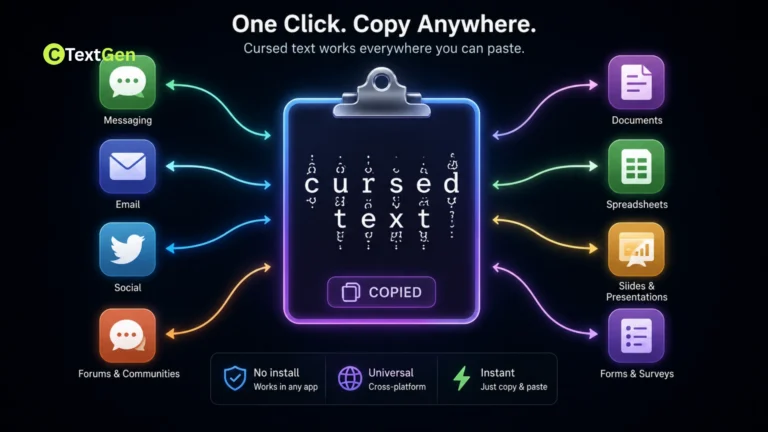
This is also why cursed text can be copied and pasted into almost any text field. It isn’t an image or a downloaded font. It’s standard text, just heavily decorated.
Why It Sometimes Breaks Chat Boxes and Apps
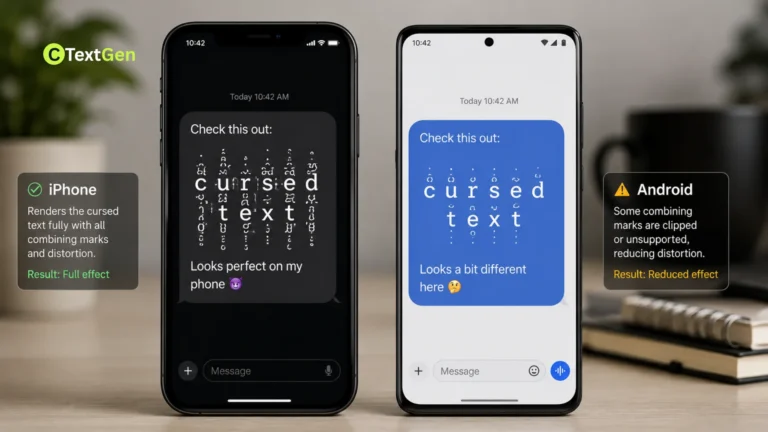
Because there’s no built-in limit on stacking, extremely dense cursed text can cause real problems. Older browsers and lower-powered devices sometimes lag while rendering dozens of overlapping marks per character. Some chat boxes and comment fields overflow or visually break under the load. A handful of platforms cap or strip combining marks specifically to prevent this, which can temporarily obscure the intended meaning of cursed text when characters get trimmed.
Cursed Text in Internet Culture Today
The role of cursed text in internet culture has changed a lot since its Something Awful days, expanding from a horror in-joke into a broadly recognized aesthetic.
Where People Actually Use It
On Reddit, entire threads exist purely to ask about the meaning of “cursed text” or what the word “cursed” itself means, which says a lot about how much curiosity still surrounds a format that’s been around for two decades. On Discord, it appears in horror-themed server names, bot messages, and channel titles intended to set an eerie tone. Gamers use it for clan tags and usernames in titles like Minecraft and Roblox, where a corrupted-looking name instantly signals a spooky or edgy vibe without any extra artwork.
Short-form platforms like TikTok and Instagram tend to favor lighter versions in bios and captions, giving creators a subtle way to weave the text’s meaning into their profile aesthetics.
A Broader Internet Slang Shift
It’s worth noting that the underlying word “cursed” has a longer linguistic history than most casual users realize, with earlier recorded uses tied to entirely different connotations before the internet reshaped it into today’s meaning of “unsettling in a funny or surreal way.” That kind of rapid shift in meaning is common in internet slang and directly influences how modern web users perceive the cursed text.
Practical Examples of Cursed Text
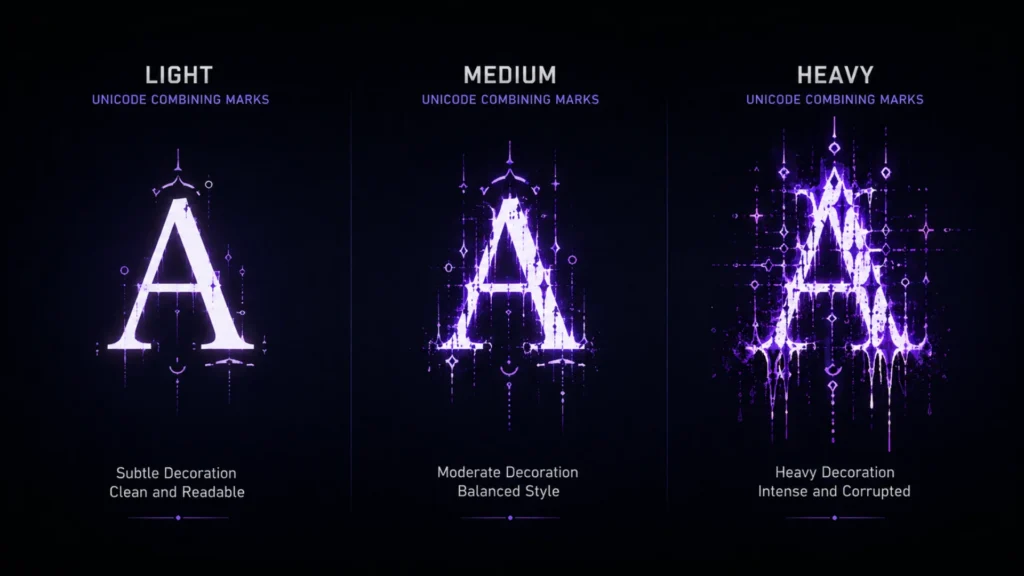
Reading about intensity levels only goes so far when studying the cursed text meaning, so here’s how they typically break down in practice:
- Light distortion: a word with a handful of marks added, giving it a subtly rough or eerie edge while staying fully readable.
- Medium distortion: visibly jagged letters with marks above and below, still legible but clearly off.
- Heavy or full Zalgo: letters buried under dense stacks that stretch several lines up and down, closer to visual static than readable text.
Most generators let you type a phrase and adjust a slider between these levels, watching the distortion build in real time.
Tips for Using Cursed Text Well
- Keep it short. A username or a two- or three-word phrase stays readable while still conveying the core cursed text meaning.
- Match intensity to context. Light distortion suits bios and comments. Heavy distortion works better as a standalone visual element, like a title or caption.
- Check how it renders before posting. Combining marks display differently across apps, so test the result before committing it anywhere public.
- Keep the plain version handy. If a platform strips the marks, you’ll want the original text ready to paste again.
Common Mistakes People Make
- Using it in long paragraphs. Heavy cursed text across an entire block of writing becomes genuinely hard to read and can come across as spam.
- Assuming it’s a font. It’s regular Unicode text with extra characters layered on, so results can vary between devices and apps rather than looking identical everywhere.
- Overlooking accessibility. Screen readers often struggle to interpret the meaning of cursed text correctly when encountering dense combining marks, so it’s best to avoid it in anything meant to be broadly accessible.
- Dropping it somewhere can disrupt formatting. Extremely heavy cursed text has occasionally been used to intentionally break chat boxes or poorly coded input fields, which is why some communities restrict or filter it outright.
Frequently Asked Questions
What is the actual meaning of the cursed text in internet slang?
It refers to text deliberately made to look corrupted, glitchy, or unsettling using stacked Unicode symbols, playing off the broader slang meaning of “cursed” as something strange or off-putting rather than anything supernatural.
Who created the original format behind the cursed text’s meaning?
There’s no single inventor, but the style traces back to a 2004 Something Awful forum member who created distorted comic strip edits referencing an entity called Zalgo, which is where the format’s popular name comes from.
Is cursed text considered a font?
No. It’s built from standard Unicode combining characters, not a downloadable font file, which is why it can be typed and pasted into nearly any app that accepts text.
Why does cursed text sometimes look cut off on certain apps?
Some platforms limit or strip combining marks to prevent lag and layout issues, so extremely dense cursed text can appear trimmed even when it was copied correctly.
Is it rude or inappropriate to send someone a cursed text?
Generally, no, since it’s just stylized text rather than offensive content, though it can come across as spammy or hard to read if overused, so context matters. For more background on how the format’s mythology developed, Reddit’s community discussion on what “cursed” means is worth a look.
Conclusion
Cursed text has stuck around for over twenty years because it turns a simple quirk of the Unicode standard into something genuinely eerie to look at. What started as a niche Something Awful joke about a comic-devouring entity named Zalgo is now a recognizable piece of internet culture, used by horror writers, gamers, and meme accounts who want their text to carry a little extra edge. Once you understand the cursed text’s meaning and the mechanics behind it, it stops being a random internet oddity and becomes a format you can use with actual intention.